Netaji Subhash Chandra Bose by Santanu Banerjee
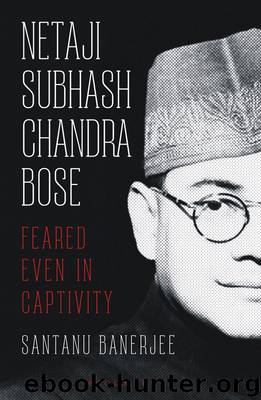
Author:Santanu Banerjee
Language: eng
Format: epub
Publisher: Bloomsbury Publishing India Pvt. Ltd
CHAPTER FOUR
Bose Weighs Options:
For the last struggle,
decides for Russia
‘Tell my countrymen, India will be free before long...’
- Bose’s last message to his nation.
I
t was March 1943, when an unhappy Bose left Germany, doubtful about an Axis victory after Hitler opened a front against the Soviet Union, with America goaded into the war and also joining the Allies in Europe.
It was not exactly known whether Bose began to explore an alternative for his next operational zone immediately after he left Europe.
However, gradually realisation dawned upon Bose that Hitler had taken more than he could chew, and simultaneously was at war with Russia, Britain, and now also America (which had entered the war in full scale).
Thus, he was doubtful about an Axis victory in Europe, and the Nazi leaders could not stop him from openly criticising Germany for having launched its military campaign against Russia.
Bose criticised Hitler’s war policy and wrote strong letters to his ministers against the attack on Russia. Most interestingly, even though, the Soviet Union had problems issuing Bose a transit visa in 1941, from Kabul for his journey into Berlin, they uttered no word against him during his stay either in Europe or in Japan.
However, Bose’s meeting Hitler in March 1942 ended in a big disappointment for him as he failed to see reasons in what the Nazi leader told him. Though Bose was always frank and dignified, he gave Hitler a piece of his mind vis-à-vis his interpretation of the war and the outcome, and it didn’t went in favour of the German leader!
However, he also realised that Germany’s interest in India’s independence wasn’t that keen, and even the German war leaders wouldn’t like to utilise the opportunity war had offered them properly, Netaji Through German Lens, by Nanada Mookherjee.
A call from South East Asia sustained Bose, as, till 1943, Japan had not got their offensives slowed down against the Anglo-American forces in Asia.
The journey by the German and Japanese submarines, which lasted 18 weeks, finally ended on 2nd July with his arrival in Singapore, and the air of welcome and victories overwhelmed him, as did his presence overwhelm the Indians and Japanese leaders.
Within a week, he assumed the supreme leadership of the Indian Independence League and the Indian National Army from another great revolutionary Rash Behari Bose, and Japan’s Prime Minister Hideki Tojo was at his side.
Soon, he was mobilising his army with speeches that had cast a hypnotic spell on millions of civilians and army men. He told his solders, ‘I want total mobilisation for a total war and nothing less’. His eloquence mixed with his charisma led millions of Indians in South East Asia to believe him, let alone the former Indian British soldiers who were now in INA. ‘At long last we have a leader we could believe,’ wrote Shah Nawaz Khan in his memoir. Khan, though willy-nilly, later become Nehru’s man.
Even Gandhi and Churchill’s biographer Arthur Herman agreed that his (Bose’s) eloquence only matched (that of) British Prime Minister's with an explicit hint at 10 Downing Street.
Download
This site does not store any files on its server. We only index and link to content provided by other sites. Please contact the content providers to delete copyright contents if any and email us, we'll remove relevant links or contents immediately.
Fanny Burney by Claire Harman(26579)
Empire of the Sikhs by Patwant Singh(23055)
Out of India by Michael Foss(16837)
Leonardo da Vinci by Walter Isaacson(13279)
Small Great Things by Jodi Picoult(7098)
The Six Wives Of Henry VIII (WOMEN IN HISTORY) by Fraser Antonia(5482)
The Wind in My Hair by Masih Alinejad(5069)
A Higher Loyalty: Truth, Lies, and Leadership by James Comey(4937)
The Crown by Robert Lacey(4782)
The Lonely City by Olivia Laing(4782)
Millionaire: The Philanderer, Gambler, and Duelist Who Invented Modern Finance by Janet Gleeson(4440)
The Iron Duke by The Iron Duke(4333)
Papillon (English) by Henri Charrière(4235)
Sticky Fingers by Joe Hagan(4166)
Joan of Arc by Mary Gordon(4076)
Alive: The Story of the Andes Survivors by Piers Paul Read(4009)
Stalin by Stephen Kotkin(3936)
Aleister Crowley: The Biography by Tobias Churton(3620)
Ants Among Elephants by Sujatha Gidla(3449)
